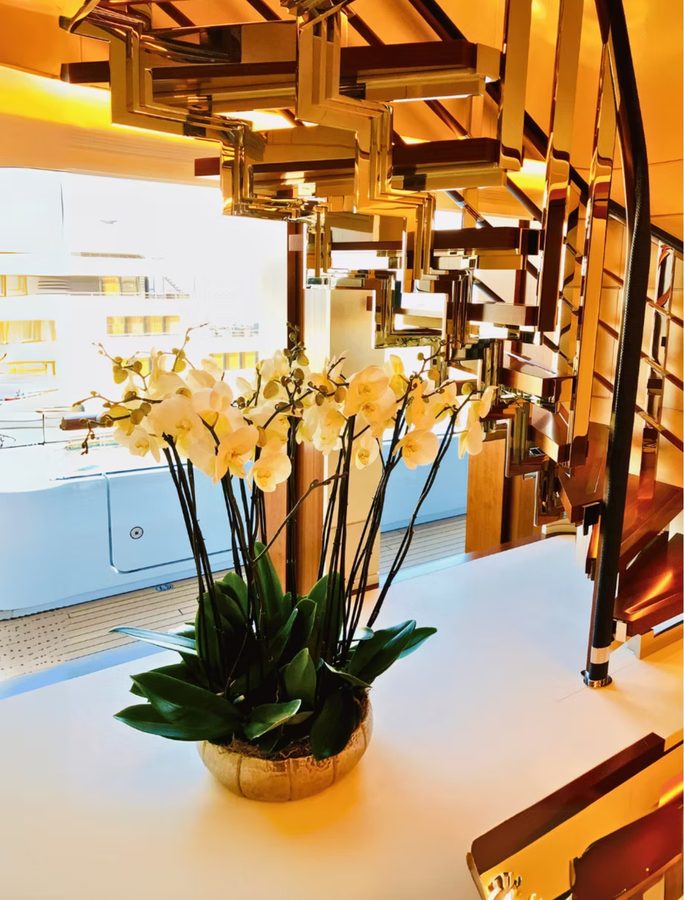
Every boat has them. A phalaenopsis in the main saloon, one in the owner's cabin, two more in the lobby, and nobody on board was ever told how they work. They are treated like cut flowers that happen to come in a pot, watered on a schedule, stood under a downlight, and six weeks later the buds drop and somebody is asked to find replacements in a port that does not sell them.
They are not difficult. They are just not what people assume they are.
Why phalaenopsis and not something else
A moth orchid is the right plant for a yacht for reasons that have nothing to do with fashion. It flowers for two to three months and sometimes longer, which no cut arrangement does. It wants very little water, so it survives a changeover weekend when nobody is thinking about it. It has no scent to fight with the food. And it looks composed in a photograph from any angle, which matters on a boat that gets photographed constantly.
The one thing to understand is that it does not grow in soil. In the wild it grows on the side of a tree, with its roots in the air and the rain running past them. That single fact explains everything below.
How often should you water an orchid on board?
Less than you think, and properly rather than often.
Take the plant to the sink, run tepid water through the bark until it is soaked, and let it drain completely before it goes back. Two minutes. What kills orchids on boats is not drought, it is the centimetre of water sitting in the bottom of a decorative cachepot that nobody tipped out. The roots sit in it, they rot, and the plant collapses weeks later for no reason anyone can see.
The plant will tell you when it wants water, and the signal is the roots, not the leaves. Silvery grey roots are dry and ready. Green roots are still wet. In most interiors that works out at roughly once a week, less when the air conditioning is heavy, more in the tropics. Judge the roots and ignore the calendar.
Do ice cubes work?
You will see the advice everywhere and it is popular for an obvious reason: it looks like a measured dose. Do not do it on a plant you care about. The orchid is a tropical plant and ice on the roots is a cold injury, and the volume of water is wrong anyway. Ninety seconds at the sink is less trouble and does the job properly.
Where does it want to sit?
Bright, with no sun falling directly on the leaves. A spot a metre back from a saloon window is close to perfect. Full tropical sun through glass will scorch the leaves in an afternoon.
The leaves tell you whether you have it right. A mid green leaf, the colour of a lettuce, is a happy plant. Very dark green means it is not getting enough light and it will not flower again. A reddish tinge on the leaf edge means it is getting too much.
Why buds drop in an air conditioned saloon
This is the one that catches everybody. A plant arrives covered in fat buds, and over a week the buds yellow and fall before they ever open. Nothing was done wrong in the obvious sense. The plant was sitting in moving cold air.
Dry air blowing across an orchid, and sharp swings between a cold saloon and a hot deck, make it shed buds to protect itself. Keep plants away from vents and away from doors to the aft deck. The same applies on the other side: a plant left in the pantry next to a hot oven gets the same shock from the opposite direction.
Fruit matters too. Ripening fruit gives off ethylene, and ethylene ages flowers and buds faster than anything else in the room. An orchid on the same counter as the fruit bowl is on a short clock.
Securing a plant on a boat that moves
A ceramic cachepot with a tall plant in it is a projectile. Put a non slip mat under every pot, use a weighted cachepot rather than a tall light one, and before a passage move the plants to the floor of a locker or into the pantry sink, lying on their side if the spike allows it. Bark does not spill the way potting soil does, which is one more reason the orchid suits a boat.
Deck is not a home for them. Salt spray on the leaves and roots finishes a phalaenopsis quickly, and the sun does the rest.
What to do when the last flower falls
Do not throw it away. You have two choices and both are fine.
Cut the spike just above the second visible node below where the lowest flower was, and there is a reasonable chance of a second spike from that point within a couple of months. Or cut the spike off at the base and let the plant put everything into new leaves and roots, which gives a stronger flowering next time. On a boat with storage below, the second option plus a rotation is the professional answer: keep two or three plants resting out of sight and swap them into the interior as each one comes into flower.
Repot into orchid bark, never into soil, when the bark has broken down to crumbs, which is usually every second year.
Can orchid plants be flown to the boat?
Yes. Plants travel alongside cut flowers, and so do the containers, the bark and the sundries. The thing to remember is that a plant is plant material like any other, so it has to be named on the import permit for the destination with everything else. If you want orchids in the interior all winter, say so in the autumn when the species list for the permit is being drawn up, not in February when you have run out. How the shipping works is set out here, and what travels well and what does not is here.
On the Riviera it is simpler still, because it is a van rather than a flight. We are five minutes from Port Vauban, so a swap of tired plants for fresh ones happens the next morning.
The short version
Soak it, drain it, never let it stand in water. Bright light, no direct sun. Away from vents, doors and the fruit bowl. Non slip mat under the pot. Cut the spike when it finishes and keep spares below. Done that way, one plant gives you three months of flower and several years of life, which no bouquet on board will ever do.
The next step
If the plants on board are tired, or you want a rotation set up for the winter, send Maxime a message on WhatsApp with the boat and where you are. We will tell you what is worth keeping and what to replace.