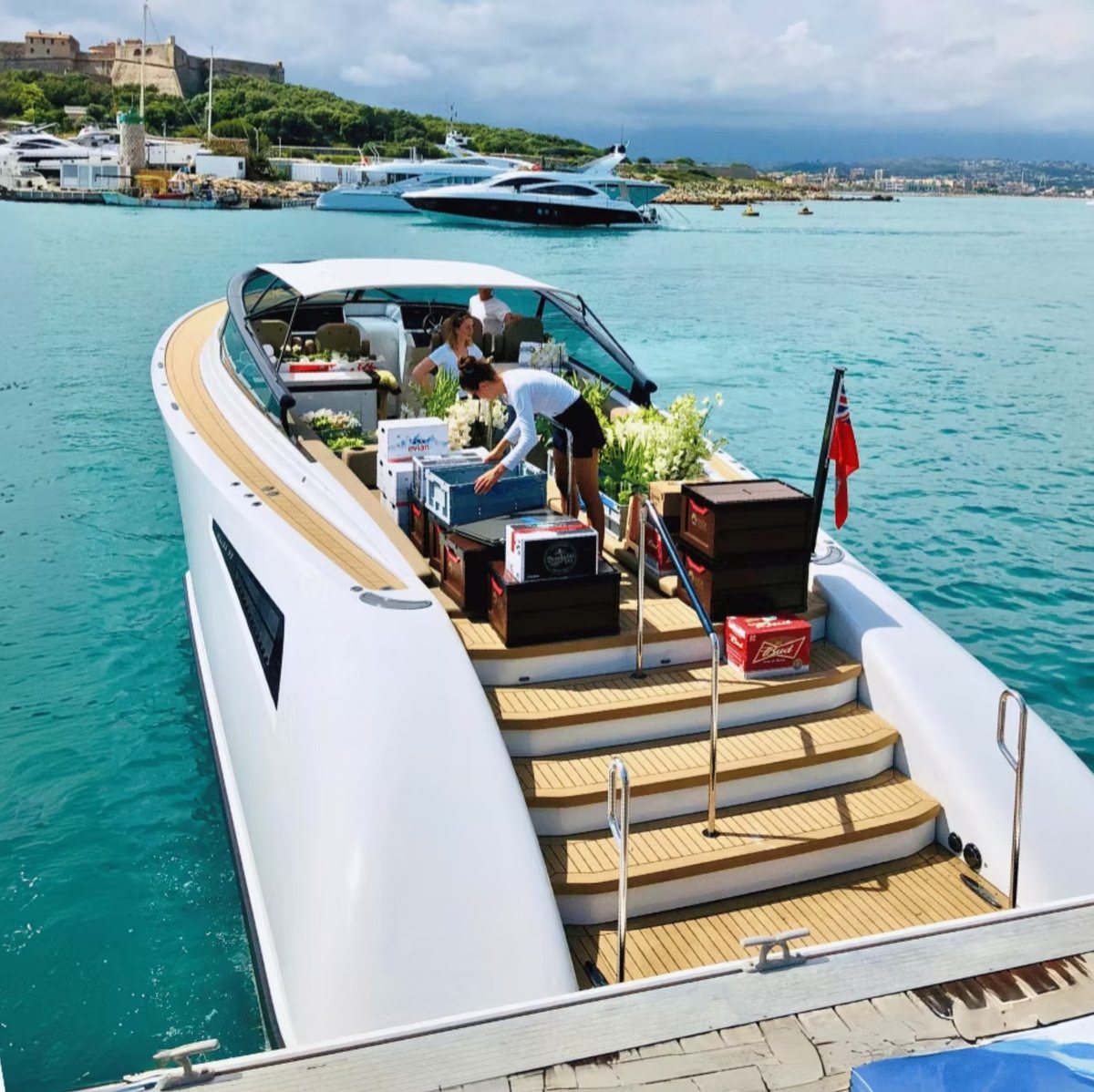
The question crew type into a search engine is usually some version of "can you get flowers in the Maldives". The useful answer has three parts: a small amount of local material is genuinely worth using, the flowers an owner actually expects are not grown here at all, and the whole thing turns on a permit that wants planning before the boat ever arrives.
This is written for the chief stewardess who has an Indian Ocean season in front of her and wants to know what she is working with.
What actually grows in the Maldives?
Plenty grows. Very little of it is a cut flower crop. Frangipani, hibiscus and bougainvillea are everywhere on the inhabited islands and around the resorts, and they are garden plants rather than commercial stems. Hibiscus opens for a day and closes. Frangipani marks brown where a thumb touched it. They were bred by nobody for vase life, because until recently nobody was asking them to spend a week in an air conditioned saloon.
Foliage is the real local asset. Palm, pandanus, large glossy leaves, and small quantities of heliconia and ginger. Foliage is sturdy, it carries the place you are actually in, and it has not spent twenty hours in a box. If there is one thing worth sourcing on the ground, it is greenery, and it is worth asking your agent what he can find before you fly in leaves that already grow outside the window.
What the islands do not have is a cut flower industry: no domestic production at any scale, no auction, no wholesaler holding stock in a cold room against the day you need it. Anything beyond foliage came off an aircraft, including whatever a shop in Malé is selling you this afternoon.
Why can the resorts not simply sell you some?
They sometimes will, and it is worth knowing what you are buying. A resort flies in flowers on a standing order built around its own occupancy, its own colours and its own arrangements. What is left over after that is a surplus, not a supply line. It arrives on the resort's schedule, in the resort's palette, in whatever quantity the week happens to leave spare.
For one vase before guests arrive, that can save a morning. For a week of tables, a saloon, cabins and a crew mess, it is a plan that depends entirely on somebody else's order going well. And the boxes were consigned to a resort, not to a yacht, which means the handover is a favour rather than a delivery.
What is worth flying in
Two things: what the islands cannot grow, and what the owner specifically expects. In practice that means the European palette, which is the whole reason anyone ships from Holland in the first place. Roses with real stem length, hydrangea, lisianthus, calla, scented stock, peonies in their season, and the greenery that goes with them where local material will not do the job.
Plants earn their freight here more than anywhere. A phalaenopsis holds in flower for weeks in an interior, so plants cut the number of shipments a long season needs rather than adding to them. The same applies to the dry goods: floral foam, containers, vases, tools and sundries all travel in the same consignment, and they count towards the 100 kg volumetric minimum, which is measured by the space the boxes occupy rather than what they weigh. Flowers are light and bulky, so a yacht order normally clears that minimum without trying.
What is not worth flying is anything that opens fast or bruises on contact. You pay full freight either way, so the stems that go in a box should be the ones that look the same at the passerelle as they did at the auction. Which flowers survive the flight is covered here.
The permit is the part that needs planning
The Maldives wants an import permit and a phytosanitary certificate for plants and plant products, and the agent must also report the arrival of the consignment to the plant quarantine inspector at the port of entry. Goods arriving without a permit can be quarantined or destroyed, which is a long way to fly a box of roses.
Allow one to two weeks for the permit, and understand what it does: it is granted before anything is bought, and it fixes the species list and the country of origin. Nothing can be substituted afterwards. If the list says Dutch grown roses and the auction that morning has better Kenyan ones, the Kenyan ones stay in Holland. So the list you give at the start of the season should be generous rather than precise, because every name left off it is a flower you cannot have in February.
The good news is that this is a once per season conversation. Plan the permit once and it stays valid for later orders on the same species list, for the rest of the season. After that every order runs at the same rhythm: 48 hours before the flowers are bought at the Dutch auction, about twenty hours in the air to Malé, and roughly three days from your message to the passerelle. We ship Monday to Friday, because the flight and the export paperwork both need a working day, so a request sent on Saturday starts moving on Monday.
How do the boxes reach a boat on an outer atoll?
Everything clears at Malé. If the boat is there, that is the end of it, and the boxes come to the passerelle cold. If the boat is two atolls away, the last leg is a seaplane or a speedboat, it wants a day of its own, and it has its own weight limits.
That leg is entirely normal and we have done it. What makes it go wrong is discovering it on the day. Tell us where the boat actually is rather than which country, and tell us at the point of ordering, so the hand over is arranged while the consignment is still being planned rather than while it sits on a warm apron.
What to send us when you ask
- The port and the date, even if the dates are provisional.
- Where the boat actually is: Malé, or which atoll, and how the last leg happens.
- The species list for the permit, written long rather than short.
- The dry goods you want held: foam, containers, vases, tools.
- How often you want a refresh through the season.
- Your agent in Malé, if the boat already has one. If not, we bring ours.
Answer those and the season stops being a series of emergencies. The Maldives page has the timings and the detail, and this is the checklist for settling it before the boat leaves the Med.
If the boat is heading east this winter, the permit is the thing to start now. Message Maxime with the port and the dates, and we will tell you honestly what is possible for your atoll.